
The KTC Solution

Today, there are two primary treatments for the disease — Dialysis or Kidney Transplant

0 k

Americans living with End–Stage Kidney Disease

Medicare Program; Alternative Payment Model Updates and the Increasing Organ Transplant Access (IOTA) Model, 89 Fed. Reg. 96280, 96294 (December 4, 2024).

0 k

Americans are on dialysis and 90,323 are on the kidney transplant waitlist

The Moran Company, The Living Organ Volunteer Engagement (LOVE) Act: Fiscal Implications (March 15, 2024), available from author.

> 0

Transplants were complete. The United States ranks 22nd in the world in transplants for people on dialysis and in 2024

The Moran Company, The Living Organ Volunteer Engagement (LOVE) Act: Fiscal Implications (March 15, 2024), available from author.

How can we support? Advocate and Educate.

The Case for Facilitator Programs

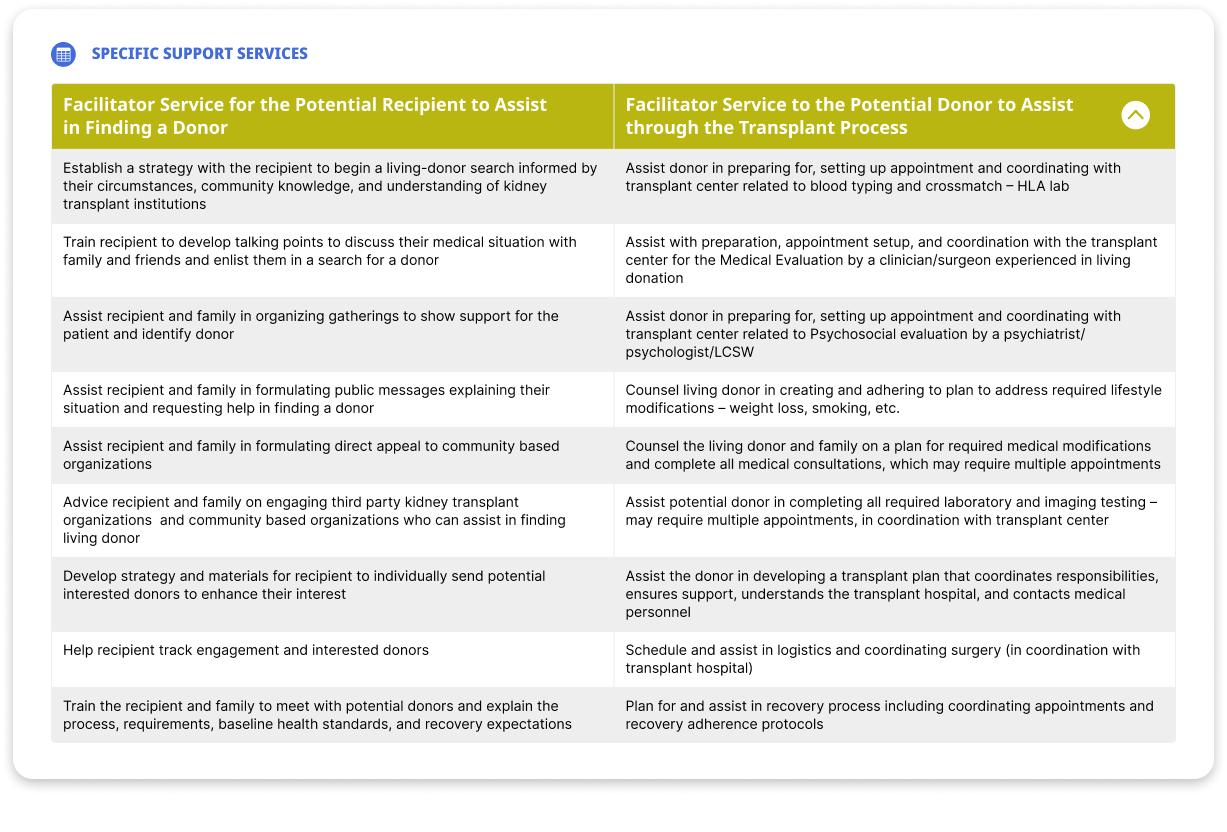
Living kidney donors save lives, yet there is no specific or coordinated federal support system to help patients find a donor or guide potential donors through the complex transplant process from start to finish.

Research shows the vast majority of Americans would consider donating, but the system lacks support. Patients are expected to find a donor on their own, while potential donors face a complex and confusing evaluation process. Of every 100 people who volunteer to donate, only 7 make it to surgery, not because they stop wanting to help, but because the process makes it too difficult to follow through.

That gap between willingness and completion is costing lives.

Only 7% of living donor volunteers ultimately make it through the process

Living donor facilitator training programs are a critical part of the solution. By training facilitators to assist patients in identifying potential donors and supporting those donors through the process, these programs provide the structure needed to turn intent into completed transplants.

“Given that only about 1% of deaths occur in a manner suitable for organ donation, there appears to be no possibility that any further increase in deceased donation will be sufficient to eliminate the shortage. Similarly, there is currently a considerable emphasis on minimizing the number of deceased donor kidneys recovered but not transplanted; however, at best, that alone might result in approximately 2000 more transplants per year, a mere dent in the problem

Matas AJ, Montgomery RA, Schold JD. The Organ Shortage Continues to Be a Crisis for Patients With End-stage Kidney Disease. JAMA Surg. 2023 Aug
1;158(8):787-788. doi: 10.1001/jamasurg.2023.0526. PMID: 37223921

A national support structure ensures both patients and donors get the guidance they need.

The LOVE Act

Today, more than 94,000 Americans are waiting for a kidney transplant, and too many remain on dialysis because the current Medicare framework does not support living donation at scale.

The Living Organ Volunteer Engagement (LOVE) Act addresses this gap by creating a Medicare-supported training program for “Living Kidney Transplant Facilitators.” These facilitators help patients identify potential donors and guide donors through the complex transplant process—dramatically increasing the likelihood of successful living donor transplants.


By allowing transplant hospitals to train and support facilitators, the LOVE Act builds the infrastructure needed to expand living donation, improve patient outcomes, and reduce long-term Medicare spending.

Executive Action

The goals of the LOVE Act can be advanced now through executive action using existing Medicare authority. Today, transplant hospitals must rely on non-Medicare funding to support living donor facilitator training, despite clear evidence these programs increase successful transplants.

Transplant Center Resources

Transplant centers need practical tools to expand living donation. The resources below — including training materials, outreach tools, and patient and donor guidance — help centers implement effective programs and move more living donor transplants from intent to completion.

Grants

KTC will award grants to fund innovative new programs and best practices that demonstrate a direct increase in kidney transplants or decrease financial obstacles and other barriers recipients, donors, and their families face in today’s kidney transplant system.

KTC Grants

Logo 1

Cambridge85’s Bold New Model Increased Kidney Transplants

Cambridge85 received a grant to launch the DDIC program, creating transplant chains from deceased donors and expanding access through a scalable, innovative model.

Logo 3

How AI Rescued Kidneys Before They Were Wasted—And Why That Mattered

A research team funded by the Kidney Transplant Collaborative developed a machine learning toolkit that predicted hard-to-place kidneys in real time, reducing discards and improving transplant decision-making across 12 Organ Procurement Organizations.

Logo 2

HonorBridge’s Bold uDCD Protocol Expanded the Frontiers of Kidney Transplantation

HonorBridge received a grant to develop a rapid organ recovery protocol for uncontrolled circulatory death donors, resulting in successful kidney transplants and setting a new standard for innovation in emergency organ donation.

Logo 5

Transparency is Power: How a KTC-Funded Study Revolutionized Patient Education in Kidney Transplantation

Columbia University and Cleveland Clinic received a grant to study personalized transplant education, demonstrating that clear, timely communication significantly improved patient understanding and increased transplant rates.

Learn more about the results from one of KTC's grants at Columbia